
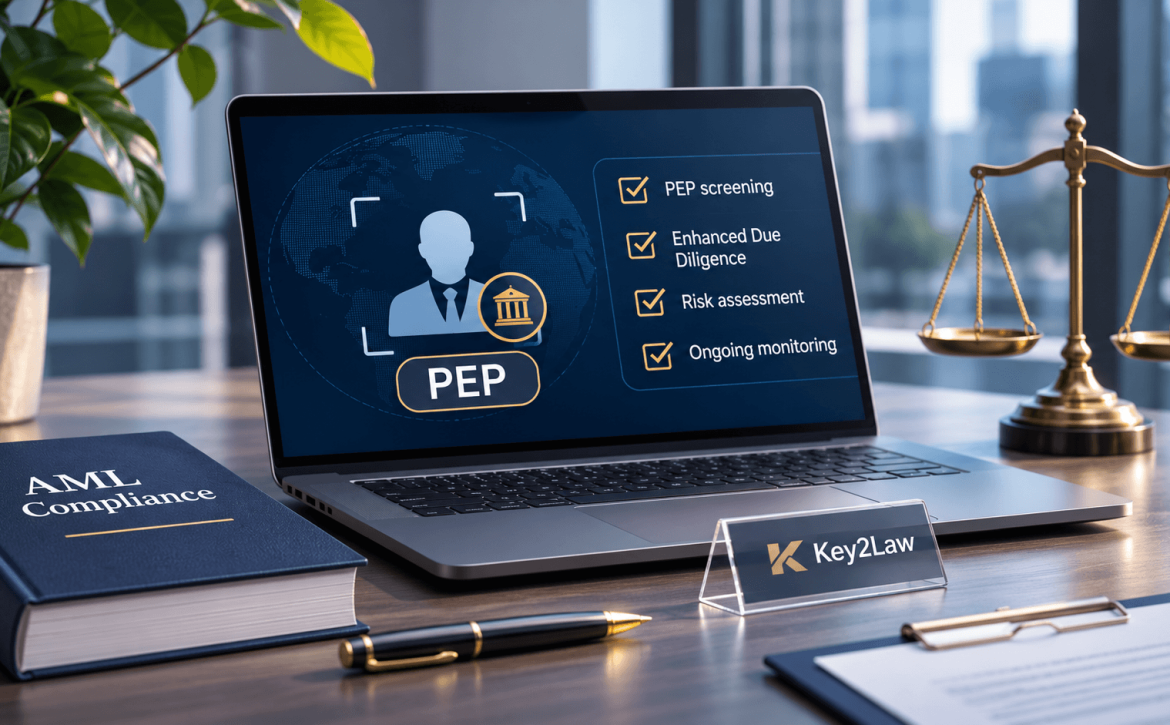
What is a PEP?

A PEP (Politically Exposed Person) is an individual who holds or has held a prominent public function and may therefore present an increased risk of corruption, bribery, or misuse of public funds. PEP status does not mean that the person has committed any wrongdoing or is involved in illegal activity.
PEP screening forms part of AML and customer due diligence frameworks. Regulated businesses generally need to determine whether a customer or beneficial owner qualifies as a PEP, assess the associated risks, and, where appropriate, apply Enhanced Due Diligence and ongoing monitoring.
PEP definition
A PEP (Politically Exposed Person) is an individual who holds or has held a prominent public function and therefore requires enhanced attention within AML risk assessment.
PEPs may include:
- Heads of state and government;
- Ministers and deputy ministers;
- Members of parliament;
- Senior judges;
- High-ranking military officers;
- Executives of state-owned enterprises;
- Senior officials of political parties;
- Other individuals holding prominent public functions.
Depending on the applicable rules, enhanced scrutiny may also extend to family members and close associates of a PEP.
In simple terms
A PEP is someone with significant public influence or access to state resources. PEP status does not itself indicate wrongdoing, but it may increase corruption and bribery risk.
Why is a PEP considered higher risk?
PEP status is associated with higher risk not because of the position itself, but because prominent public functions may involve access to public funds, influence, and decision-making power. This can increase exposure to corruption, bribery, embezzlement, and other financial crime risks.
Regulated businesses therefore commonly apply enhanced measures to PEPs, which may include:
- Enhanced Due Diligence;
- More detailed source of funds and source of wealth checks;
- Senior management approval;
- More frequent customer profile reviews;
- Ongoing transaction monitoring;
- Additional checks on related entities, family members, and close associates.
A PEP should not automatically be treated as a suspicious customer. The AML approach should remain risk-based and consider jurisdiction, role, transaction profile, and other relevant factors.
How does PEP screening work?
PEP screening helps regulated businesses determine whether a customer, beneficial owner, or another connected person falls within the Politically Exposed Person category.
A typical process includes:
- Customer identification. The business collects key information about the customer and beneficial owners.
- Screening. The information is checked against PEP databases, public sources, and other available records.
- Match review. If a potential match is found, the business must confirm whether it relates to the actual person rather than a false positive.
- Risk assessment. The person’s role, jurisdiction, business relationship, and expected transactions are assessed.
- Enhanced Due Diligence. Higher-risk cases may require additional documents and source of wealth/source of funds checks.
- Ongoing monitoring. PEP status and customer activity are reviewed periodically.
PEP screening should not rely solely on automated database checks. Context is important to distinguish false positives, outdated information, and genuine risk factors.
Examples of PEPs
PEP status may apply to current and former holders of prominent public functions and, in some cases, to persons connected with them.
Example 1. Government minister
A serving minister opens an account with a financial institution. Their PEP status requires additional risk assessment and, where appropriate, Enhanced Due Diligence.
Example 2. Executive of a state-owned company
A senior executive of a major state-owned enterprise may fall within the PEP definition if the role meets the applicable criteria.
Example 3. Family member
A close family member of a senior public official becomes a customer of a fintech company. Depending on the jurisdiction, additional AML checks may apply.
Example 4. Former PEP
An individual left a prominent public position several years ago. This does not always mean that enhanced monitoring ends automatically, as the business may still consider retained influence, relationships, and other risk factors.
PEP vs Sanctions
PEP screening and sanctions screening are different elements of AML compliance. PEP status indicates increased corruption risk, while sanctions screening checks whether a person or entity is subject to official restrictive measures.
|
Feature |
PEP |
Sanctions |
|
What the status means |
The person holds or has held a prominent public function |
The person or entity is subject to a sanctions regime |
|
Main risk |
Corruption, bribery, misuse of public funds |
Breach of sanctions restrictions |
|
Automatic prohibition on the relationship |
Usually no |
May apply depending on the sanctions regime |
|
Main control |
Enhanced Due Diligence and ongoing monitoring |
Screening, blocking/restrictions, and reporting where required |
|
Primary sources |
PEP databases, public records, official information |
Official sanctions lists and applicable regulatory sources |
|
Can the status change? |
Yes, particularly after leaving public office |
Yes, if sanctions are amended or removed |
The key difference is that PEP status does not itself prohibit a business relationship, while sanctions may directly restrict or prohibit certain transactions.
Frequently Asked Questions
What does PEP mean?
PEP (Politically Exposed Person) is an individual who holds or has held a prominent public function and may therefore present a higher corruption risk.
Is a PEP automatically a suspicious customer?
No. PEP status does not itself indicate wrongdoing. It means the customer may require closer risk assessment and, where appropriate, Enhanced Due Diligence.
Are family members considered PEPs?
Depending on the applicable rules, enhanced measures may also apply to close family members and close associates of a PEP.
How long does PEP status continue after leaving office?
This depends on the jurisdiction and the risk-based assessment. Enhanced monitoring may continue after the person leaves public office if influence or related risks remain.
Can a business provide services to a PEP?
Usually yes, unless applicable rules provide otherwise. However, regulated businesses may need to apply additional checks, senior management approval, and ongoing monitoring.
Key takeaways
- PEP (Politically Exposed Person) is an individual who holds or has held a prominent public function.
- PEP status does not indicate wrongdoing, but it may signal a higher corruption risk.
- PEPs often require Enhanced Due Diligence, source of wealth/source of funds checks, and ongoing monitoring.
- Enhanced scrutiny may also extend to family members and close associates.
- PEP screening and sanctions screening are different processes, and PEP status does not automatically prohibit a business relationship.
Please fill in the form and we will get in touch with
you as soon as possible
