
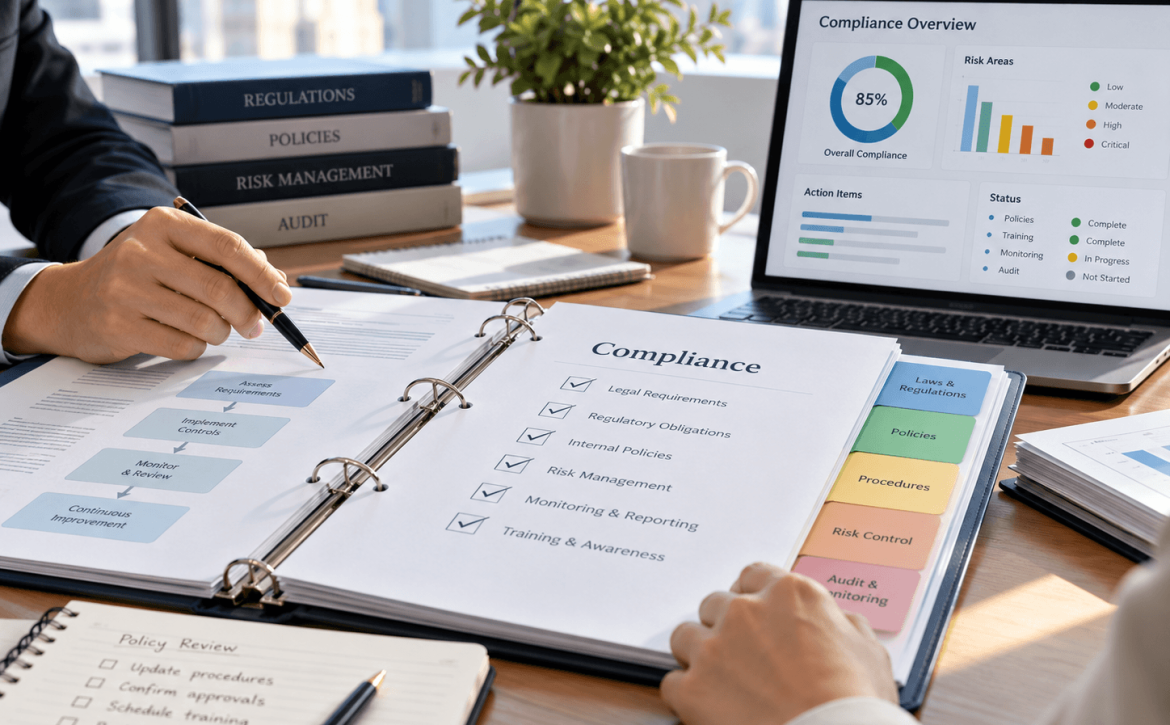
What is compliance?

Compliance means following the laws, regulations, standards, internal policies, and contractual obligations that apply to a business or organization. It helps companies operate within legal requirements and reduce the risk of violations, penalties, disputes, or regulatory action.
Compliance can cover many areas, including corporate governance, AML and KYC, data protection, financial reporting, employment rules, licensing, sanctions, and industry-specific regulation. The exact obligations depend on the company’s activities, jurisdiction, customers, and regulatory status.
Compliance definition
Compliance is the process of ensuring that a business follows the legal, regulatory, contractual, and internal rules that apply to its activities. It can include both external requirements, such as legislation and regulatory obligations, and internal controls created by the company to manage risk and maintain consistent standards.
The scope of compliance depends on the industry and jurisdiction. A regulated financial or crypto business may need to follow licensing, AML, KYC, sanctions, reporting, and consumer protection requirements, while other companies may focus more on areas such as employment law, data protection, tax obligations, or corporate governance.
In simple terms
Compliance means making sure a company operates according to the rules it is required to follow. This includes understanding the relevant obligations, putting appropriate procedures in place, and checking that those procedures are actually followed in practice.
How does compliance work?
Compliance works by turning legal and regulatory requirements into internal processes that employees can follow in practice. A company first identifies which rules apply to its activities, then creates controls, policies, and monitoring procedures to manage those obligations.
A typical compliance process includes:
- Identifying applicable requirements. The company determines which laws, regulations, licences, contractual obligations, and internal standards apply.
- Creating policies and controls. Procedures are introduced for areas such as customer onboarding, reporting, approvals, recordkeeping, or risk management.
- Assigning responsibility. Specific employees or compliance officers are responsible for implementing and supervising the controls.
- Monitoring and updating. The company reviews whether procedures are followed and updates them when laws, risks, or business activities change.
Effective compliance is therefore not limited to having written policies. The controls need to work in day-to-day operations and be supported by appropriate records, oversight, and regular review.
Why is compliance important?
Compliance is important because regulatory failures can lead to fines, licence restrictions, litigation, operational disruption, and reputational damage. For regulated businesses, weak compliance controls may also affect relationships with banks, payment providers, investors, and business partners.
A strong compliance framework helps a company:
- Identify legal and regulatory risks early;
- Reduce the likelihood of violations and enforcement action;
- Maintain required records and reporting processes;
- Support consistent decision-making across the business;
- Demonstrate to regulators and counterparties that appropriate controls are in place.
Compliance also becomes more important as a company grows, enters new markets, or launches new products. Each change can create additional legal obligations, so controls need to develop together with the business rather than remain static.
Compliance for business and regulated industries
Compliance requirements become especially important for businesses operating in regulated sectors such as financial services, fintech, crypto, payments, and investment services. These companies may be subject to licensing conditions, AML and KYC obligations, sanctions screening, transaction monitoring, reporting, governance, and consumer protection rules.
For example, a crypto exchange may need controls for customer identification, suspicious transaction monitoring, recordkeeping, and regulatory reporting. A fintech company may also need to manage data protection, outsourcing, safeguarding, and internal governance requirements.
Compliance should therefore be integrated into day-to-day operations rather than treated as a separate legal formality. Key2Law helps businesses assess regulatory requirements, review internal compliance frameworks, and align operational processes with applicable legal obligations, particularly when entering new markets or preparing for licensing.
Examples of compliance
Compliance looks different depending on the industry and the rules that apply to a business.
Example 1. Customer due diligence
A regulated financial or crypto company verifies customer identities, checks sanctions exposure, and assesses risk before providing services. These procedures support AML and KYC compliance.
Example 2. Regulatory reporting
A licensed business collects and submits required information to a regulator within the applicable deadlines. This may include transaction data, financial reports, compliance records, or information about material changes in the business.
Example 3. Internal controls
A company introduces approval procedures, access restrictions, recordkeeping rules, and staff responsibilities to reduce the risk of regulatory breaches and ensure that important decisions can be reviewed later.
These examples show that compliance is not a single action. It is an ongoing system of controls designed to make sure that legal and regulatory obligations are followed in everyday business operations.
Compliance vs risk management
Compliance and risk management overlap, but they are not the same. Compliance focuses on meeting legal, regulatory, and internal requirements, while risk management has a broader purpose: identifying and controlling financial, operational, strategic, legal, and other business risks. In practice, compliance is often one part of a wider risk management framework.
Frequently asked questions
What does compliance mean?
Compliance means following the laws, regulations, internal policies, contractual obligations, and standards that apply to a business.
Why is compliance important?
Compliance helps reduce legal and regulatory risks, avoid penalties, support licensing requirements, and maintain reliable business operations.
What is a compliance program?
A compliance program is a structured system of policies, controls, responsibilities, monitoring, and reporting designed to help a company meet its legal and regulatory obligations.
Who is responsible for compliance in a company?
Responsibility may be shared between management, compliance officers, legal teams, risk teams, and operational staff. In regulated businesses, specific compliance roles may also be required by law or licensing conditions.
Key takeaways
- Compliance means following the legal, regulatory, contractual, and internal rules that apply to a business.
- Effective compliance requires practical controls, clear responsibilities, monitoring, and regular updates.
- Compliance is especially important for regulated sectors such as fintech, crypto, payments, and financial services.
- A strong compliance framework helps reduce legal risk, support licensing, and maintain reliable business operations.
Please fill in the form and we will get in touch with
you as soon as possible
