
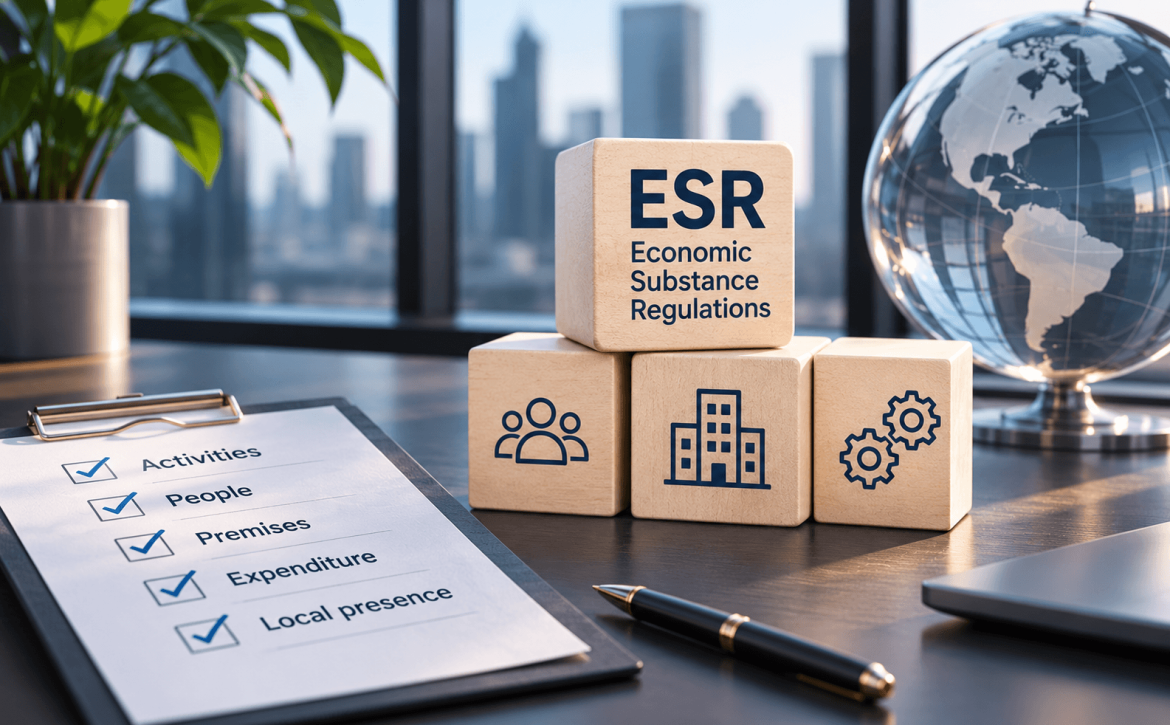
What is ESR?

ESR (Economic Substance Regulations) are rules designed to ensure that companies earning income from certain activities maintain sufficient real economic presence in the relevant jurisdiction. These requirements commonly assess where a company actually conducts its activities, makes key decisions, and uses the resources required for its business.
ESR are particularly relevant to international corporate structures, holding companies, financial businesses, and other entities operating in jurisdictions with specific economic substance rules. Exact requirements vary by country, but businesses generally need to determine whether their activities fall within the ESR framework and, where applicable, demonstrate an adequate level of substance.
ESR definition
ESR (Economic Substance Regulations) are rules designed to ensure that companies demonstrate real economic presence in the jurisdiction where they claim to conduct certain business activities or earn related income.
Depending on the jurisdiction, economic substance requirements may consider:
- Where key management decisions are made;
- Where core income-generating activities are performed;
- The presence of qualified employees;
- Physical premises and operational resources;
- An adequate level of expenditure;
- The actual nature of business operations.
In simple terms
ESR assesses whether a company has real business activity rather than only a registered or formal corporate presence. The specific ESR framework must always be reviewed on a jurisdiction-by-jurisdiction basis. Relevant activities, reporting obligations, exemptions, and substance tests may differ significantly.
Which companies may be subject to ESR?
ESR generally do not apply to every company automatically. They usually target entities carrying out specific activities or earning income that falls within the economic substance rules of a particular jurisdiction.
The list of relevant activities varies by country, but ESR may commonly affect:
- Holding companies;
- Headquarters businesses;
- Financing and leasing activities;
- Fund management;
- Insurance businesses;
- Banking activities;
- Shipping businesses;
- Intellectual property businesses;
- Distribution and service centre activities.
Incorporation in a jurisdiction does not necessarily mean that ESR automatically apply. Businesses generally need to determine whether they carry out a relevant activity, earn related income, and qualify for any available exemption.
For international groups, each entity should be assessed separately because ESR obligations may differ even within the same corporate structure.
How does ESR compliance work?
ESR compliance usually starts with an assessment of the company’s activities to determine whether it falls within the economic substance rules of a particular jurisdiction. If the requirements apply, the company may need to demonstrate that its local presence is proportionate to the nature and scale of the relevant activity.
A typical process includes:
- Identifying the relevant activity. The company determines whether its business falls within categories covered by local ESR.
- Reviewing exemptions. It assesses whether the entity may fall outside the substance test under the applicable rules.
- Testing economic substance. The review considers where decisions are made, where core income-generating activities are performed, and which resources are used.
- Assessing local presence. Employees, premises, expenditure, and operational capacity may be reviewed.
- Reporting. Where required, the company submits notifications or an economic substance return within the applicable deadline.
- Ongoing review. Substance should be maintained in practice throughout the relevant period rather than demonstrated only on paper.
The broader ESR principle reflects the concept of substantial activity: tax or regulatory advantages should not be available solely on the basis of formal presence without genuine economic activity. This principle forms part of the OECD’s BEPS Action 5 work.
What are the risks of ESR non-compliance?
If a company falls within Economic Substance Regulations but fails to meet the applicable requirements, the consequences can be significant. Exact measures depend on the jurisdiction, but authorities may assess both the actual level of substance and the accuracy of reporting.
Possible consequences may include:
- Financial penalties;
- Repeated or increased fines for continued non-compliance;
- Additional information requests and regulatory review;
- Exchange of information with foreign tax authorities;
- Restrictions or adverse consequences affecting corporate status;
- Reputational risks for the group and beneficial owners.
The risk is particularly high where a company claims presence in a jurisdiction while key decisions, employees, and business operations are actually located elsewhere.
For this reason, ESR compliance should be assessed not only through documentation but also against the company’s real operating model.
Examples of ESR
Economic Substance Regulations are easier to understand through practical scenarios where a company’s formal structure is compared with its actual business activity.
Example 1. Holding company
A company holds shares in subsidiaries and receives dividend income. Depending on the jurisdiction, specific substance requirements may apply to holding activities.
Example 2. Financing business
An entity provides loans to other group companies and earns interest income. Authorities may assess where lending decisions are made, who manages the financing activity, and whether sufficient local resources are available.
Example 3. IP business
A company receives royalty income from intellectual property. For these structures, it may be particularly important to demonstrate where the relevant IP is developed, managed, and commercially exploited.
Example 4. Headquarters activity
A company coordinates management and strategic functions for an international group. ESR assessment may consider the location of decision-making, qualified personnel, office presence, and the level of expenditure.
ESR vs Tax Residency
Economic Substance Regulations and tax residency may be analysed at the same time, but they address different questions.
|
Feature |
ESR |
Tax Residency |
|
Main question |
Does the company have sufficient real economic activity in the jurisdiction? |
In which country is the company treated as tax resident? |
|
What is assessed |
Employees, premises, expenditure, decision-making, and core activities |
Incorporation, management and control, place of effective management, and other local tests |
|
Main purpose |
Prevent the use of formal structures without sufficient substance |
Determine which jurisdiction may tax the company as a resident |
|
Outcome |
Assessment of whether substance requirements are met |
Determination of the company’s tax residence |
|
Reporting |
May require a separate ESR notification or return |
Usually reflected through tax registrations and filings |
|
Can both apply? |
Yes |
Yes |
A company may satisfy ESR while its tax residency still requires a separate assessment. Likewise, being tax resident in a jurisdiction does not necessarily mean that every applicable economic substance requirement has been met.
Frequently Asked Questions
What does ESR mean?
ESR (Economic Substance Regulations) are rules under which companies in certain jurisdictions may be required to demonstrate sufficient real economic presence.
Do all companies have to comply with ESR?
No. Application depends on the jurisdiction, type of activity, source of income, and available exemptions. Each entity generally needs to be assessed separately.
What counts as economic substance?
Authorities commonly look at genuine business activity, decision-making, employees, premises, operating expenditure, and performance of core income-generating activities.
How is ESR different from tax residency?
ESR asks whether a company has sufficient real substance in a particular jurisdiction. Tax residency determines where the company is treated as resident for tax purposes.
What can happen if ESR requirements are not met?
Depending on the jurisdiction, consequences may include financial penalties, additional regulatory review, information exchange with foreign tax authorities, and other adverse consequences.
Key takeaways
- ESR (Economic Substance Regulations) may require certain companies to demonstrate genuine economic activity in the relevant jurisdiction.
- ESR applicability depends on the country, business activity, source of income, and available exemptions.
- Substance assessments commonly consider decision-making, employees, premises, expenditure, and core income-generating activities.
- ESR and tax residency are related but separate concepts and should be assessed independently.
- Failure to meet ESR requirements may lead to penalties, additional regulatory review, and other adverse consequences.
Please fill in the form and we will get in touch with
you as soon as possible
