
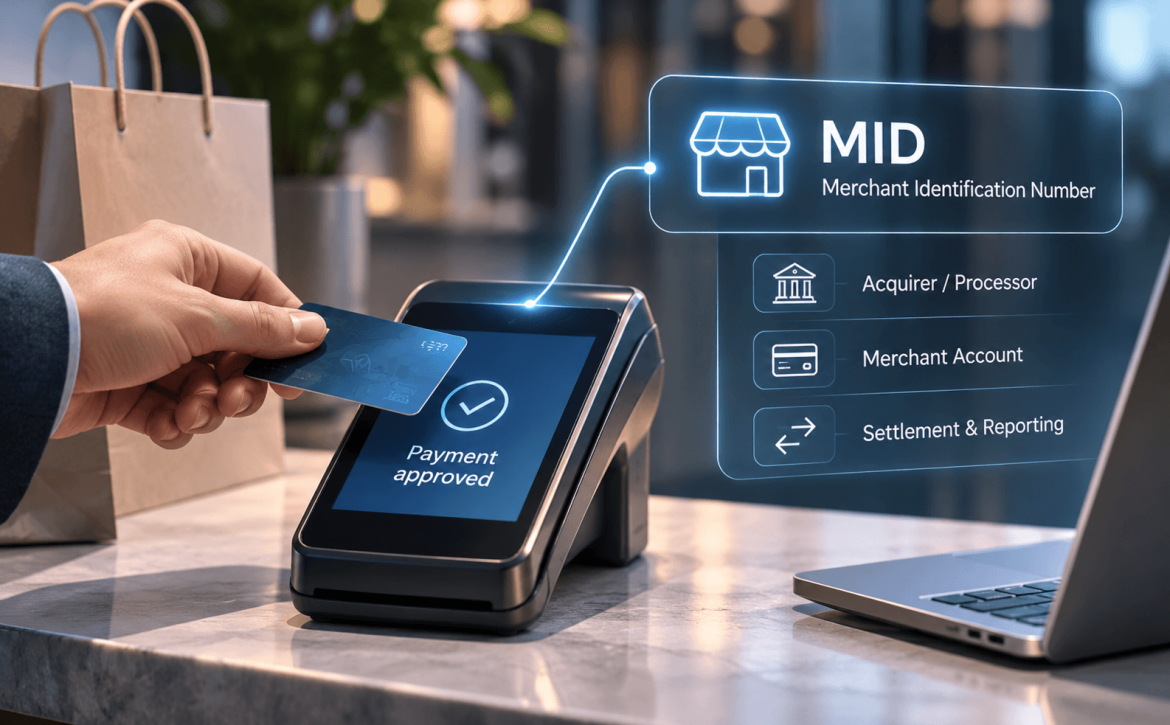
What is MID?

MID (Merchant Identification Number), also known as a Merchant ID, is a unique identifier used in payment processing to identify a particular merchant or merchant account. It helps the acquiring bank, payment processor, and other participants in the payment chain determine which business is accepting the payment and which merchant relationship the transaction belongs to.
A MID is typically assigned by an acquiring bank or payment provider when a merchant is onboarded for card payment processing. However, not every business sees or manages a MID directly: some payment platforms use their own infrastructure and provide merchant account functionality without issuing a separate MID to each user.
MID definition
MID (Merchant Identification Number) is a unique merchant identifier used to link card transactions to a specific business or merchant account.
A MID helps the payment ecosystem determine:
- Which merchant is accepting the payment;
- Which acquirer or processor handles the transaction;
- Which merchant account the settlement belongs to;
- Where refunds, chargebacks, and other payment events should be recorded.
A MID should not be confused with a bank account number, IBAN, or card number. It is used within payment infrastructure specifically to identify a merchant relationship.
In simple terms
If a merchant account is the payment infrastructure used by a business, the MID can be viewed as its unique identifier within the processing system.
How does MID work?
A MID is used during card payment processing to link a transaction to a specific merchant.
A typical process looks like this:
- The customer initiates a payment. Card data is transmitted through a payment gateway or other payment infrastructure.
- The transaction enters the processing system. The system identifies the merchant associated with the relevant MID.
- The acquirer and card network process the request. The MID helps attribute the transaction to the correct merchant account.
- The payment is approved or declined. The result is returned to the merchant.
- Settlement is linked to the merchant. Once processing is completed, the funds are recorded within the relevant merchant relationship.
The MID may also be used for refunds, disputes, chargebacks, and reconciliation. This allows the payment provider to determine which merchant each payment event belongs to.
Why does a merchant need a MID?
A MID is primarily used to identify a merchant correctly within the payment infrastructure. It allows the payment provider to separate one business’s activity from another and properly record payments, refunds, chargebacks, and settlements.
For a merchant, the MID is particularly relevant for:
- Payment and settlement reconciliation;
- Chargeback and dispute investigation;
- Transaction history analysis;
- Communication with an acquiring bank or payment processor;
- Separating different business lines, websites, or sales channels.
A single business may have multiple MIDs. For example, a company may use separate merchant identifiers for different brands, countries, currencies, websites, or payment flows. This can make reporting and risk management easier.
However, having multiple MIDs does not mean that the business has multiple separate companies. A MID identifies a merchant relationship within a payment processing system, not the legal entity itself.
MID and other payment identifiers
A MID is not the only identifier used in card processing. Within the same payment infrastructure, a merchant may have several different IDs, each serving a separate function.
For example:
- MID (Merchant Identification Number) identifies the merchant or a specific merchant relationship;
- TID (Terminal ID) usually identifies a particular payment terminal, POS device, or processing endpoint;
- A merchant account number may be used by the provider for internal account administration;
- A gateway ID may identify the merchant within a particular payment gateway system.
A single MID may also be associated with several TIDs where the merchant accepts payments through multiple terminals or sales channels.
The key distinction is the level of identification: MID identifies the merchant, while other IDs may identify a particular device, account, or technical payment channel.
Where can you find a MID?
A merchant may not always see its MID in a standard banking interface because this identifier belongs specifically to the payment processing infrastructure.
Depending on the provider, a MID may appear in:
- The merchant dashboard;
- The acquiring agreement;
- Monthly processing statements;
- Settlement or reconciliation reports;
- Merchant onboarding documents;
- Information provided by the acquiring bank or payment processor support team.
The field name may vary. It can appear as Merchant ID, Merchant Identification Number, Merchant Number, or a similar label.
If a business uses a payment platform with an aggregated merchant model, a separate MID may not be provided directly. In that case, the merchant may instead work with an internal account ID or another identifier used by the specific provider.
Examples of MID
Practical examples help show how a MID functions within payment processing infrastructure.
Example 1. Online store
An e-commerce business accepts card payments through an acquiring provider. The store’s transactions are linked to its MID, allowing the processor to record payments, refunds, and settlements correctly.
Example 2. Multiple brands
A company operates several online stores and receives a separate MID for each brand. This helps separate transaction flows, reporting, and chargeback statistics.
Example 3. International merchant
A business accepts payments in different markets through multiple acquiring relationships. Different MIDs may be used for separate countries or processing setups.
Example 4. Chargeback
A customer disputes a card transaction. The MID helps the acquirer and processor identify the merchant associated with the disputed transaction and route the dispute to the correct merchant account.
MID vs TID vs Merchant Account
MID, TID, and a merchant account are all connected with card payment processing, but they serve different purposes.
|
Feature |
MID |
TID |
Merchant Account |
|
What it is |
Merchant Identification Number |
Terminal Identification Number |
Account or payment relationship used to process card payments |
|
What it identifies |
Merchant or merchant relationship |
Specific terminal, device, or processing endpoint |
Merchant’s payment infrastructure with an acquirer or provider |
|
Main purpose |
Link transactions to a specific merchant |
Identify the terminal or channel used for a payment |
Process and account for card payments |
|
Who assigns it |
Usually the acquirer or payment provider |
Usually the processor, acquirer, or terminal provider |
Established through an acquirer or payment provider |
|
Can there be multiple? |
Yes, one business may have several MIDs |
Yes, one MID may be linked to multiple TIDs |
Yes, depending on the setup and providers |
|
Used for |
Payments, refunds, settlements, chargebacks, reconciliation |
Terminal-level transaction tracking |
Card processing and settlement |
Key takeaways
- MID (Merchant Identification Number) is a unique identifier for a merchant or merchant relationship within a payment processing system.
- A MID helps link payments, refunds, settlements, chargebacks, and other payment events to the correct merchant.
- One business may have multiple MIDs for different brands, websites, markets, or processing setups.
- A MID is not a bank account number, IBAN, or TID and serves a separate function within payment infrastructure.
- A merchant may find its MID in acquiring documents, processing statements, a merchant dashboard, or by contacting the payment provider.
Frequently Asked Questions
What does MID mean in payments?
MID (Merchant Identification Number) is a unique identifier used by an acquiring bank or payment processor to identify a merchant and the transactions associated with it.
Who assigns a MID?
A MID is typically assigned by an acquiring bank or payment provider when a business is onboarded for card payment processing.
Can one business have multiple MIDs?
Yes. Separate MIDs may be used for different websites, brands, countries, currencies, or payment flows.
Is a MID the same as a merchant account?
No. A merchant account refers to the payment infrastructure and relationship with the provider, while the MID identifies the merchant within the processing system.
Can a MID be changed?
A MID is generally assigned by the provider and is not chosen by the merchant. A new MID may be issued if the business changes acquirers, opens a new merchant account, or changes its processing setup.
Please fill in the form and we will get in touch with
you as soon as possible
