
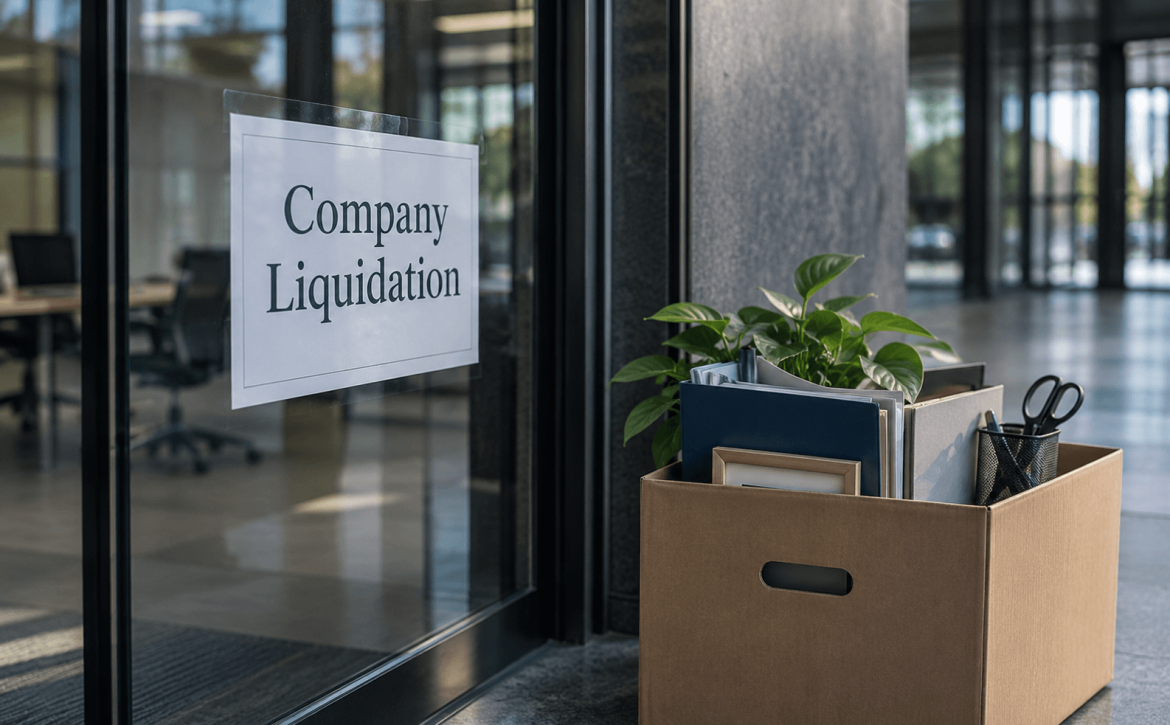
What is Liquidation?

Liquidation is the process of winding up a company by selling or realising its assets, settling liabilities in the required order, and distributing any remaining value to members or shareholders. The process usually ends with the company ceasing to exist as a legal entity.
Liquidation may be voluntary, following a decision by the owners, or compulsory as a result of insolvency, court proceedings, or other grounds provided by applicable law. The exact procedure depends on the jurisdiction, the company’s financial position, and the reason for closure.
Liquidation definition
Liquidation is a formal process of winding up a company by identifying and realising its assets, settling creditor claims in the required order, and distributing any remaining value to owners or shareholders.
Liquidation commonly involves:
- Stopping or reducing business operations;
- Collecting and realising assets;
- Reviewing outstanding debts and claims;
- Paying creditors;
- Completing tax and reporting obligations;
- Distributing residual assets;
- Formally closing and removing the company from the relevant register.
In simple terms
Liquidation means that a company ends its activities and closes through a formal process. Its assets are used to settle outstanding obligations, and once the process is complete, the legal entity usually ceases to exist.
Main types of Liquidation
Liquidation can arise for different reasons. The exact classification depends on the jurisdiction, but the most common distinction is between voluntary and compulsory liquidation.
Voluntary liquidation
Voluntary liquidation is initiated by shareholders or owners. It may be used when a company is no longer needed, has completed a project, is being restructured, or the owners decide to close the business.
Compulsory liquidation
Compulsory liquidation is initiated through a court or another procedure established by law rather than by the company itself. It is often linked to insolvency, unpaid debts, or creditor action.
Solvent and insolvent liquidation
It is also useful to distinguish between:
- Solvent liquidation – the company is able to pay its liabilities;
- Insolvent liquidation – the company does not have enough assets to satisfy all creditors in full.
The type of liquidation affects the procedure, creditor involvement, distribution of assets, and the duties of directors.
How are assets distributed in Liquidation?
During liquidation, company assets are primarily used to settle outstanding liabilities. The order of payment depends on the jurisdiction and applicable insolvency rules, but creditors generally rank ahead of shareholders or owners.
The process may involve:
- Secured creditors;
- Employees and certain preferential claims;
- Tax authorities;
- Unsecured creditors;
- Subordinated claims;
- Shareholders or members, if value remains after all higher-ranking claims are settled.
If the company is insolvent, its assets may not be sufficient to pay all creditors in full. In that case, distributions are made according to the applicable priority rules and the value available.
Shareholders generally receive residual value only after creditor claims have been dealt with in accordance with the applicable rules.
Liquidation and directors’ responsibilities
During liquidation, directors can no longer treat the situation as ordinary business operations. If the company is in serious financial distress, management decisions may also be assessed in light of creditor interests and preservation of company assets.
Particular attention may be given to:
- Accurate financial and corporate records;
- Preservation of company assets;
- Avoidance of preferential or improper transactions;
- Timely cooperation with the liquidator;
- Disclosure of debts, contracts, and assets;
- Compliance with applicable insolvency and reporting requirements.
If directors entered into transactions before liquidation that worsened the position of creditors or removed assets from the company, those transactions may be reviewed and, in some jurisdictions, challenged.
Preparing for liquidation therefore often involves not only formal closure but also review of recent transactions, liabilities, and management actions.
Examples of Liquidation
Liquidation may take place both in a financially healthy company and in a business that can no longer meet its obligations.
Example 1. Voluntary closure
Shareholders decide to close a profitable company because its project has ended and no further operations are planned. The company settles its liabilities, realises remaining assets, and distributes residual value to shareholders.
Example 2. Insolvent company
A company cannot service its debts and does not have enough assets to pay all creditors in full. Liquidation is used to realise assets and distribute available value according to the applicable priority rules.
Example 3. Corporate restructuring
A corporate group liquidates an inactive subsidiary following a restructuring. Before closure, outstanding contracts, liabilities, and corporate and reporting formalities must be completed.
Example 4. Creditor action
A creditor starts the applicable procedure against a company that has failed to pay an outstanding debt. If the required grounds are met, the process may result in compulsory liquidation.
Liquidation vs Bankruptcy
Liquidation and bankruptcy are related to financial distress and business closure, but they are not the same. Liquidation describes the process of winding up a company and distributing its assets, while bankruptcy generally refers to a formal insolvency procedure under applicable law.
|
Feature |
Liquidation |
Bankruptcy |
|
Main purpose |
Wind up the company and distribute assets |
Address insolvency and creditor claims |
|
Financial condition |
May involve either a solvent or insolvent company |
Usually connected with insolvency |
|
Outcome |
The company generally ceases to exist |
May lead to liquidation, restructuring, or another insolvency outcome |
|
Who may initiate it |
Owners, shareholders, creditors, or a court |
Debtor, creditors, or other parties depending on jurisdiction |
|
Assets |
Realised and distributed under applicable priority rules |
Treatment of assets depends on the bankruptcy framework |
|
Typical use |
Business closure or winding up |
Formal resolution of financial insolvency |
The key distinction is that liquidation describes the winding-up and asset distribution process itself, while bankruptcy is a broader insolvency procedure that does not always result in immediate closure of the company.
Frequently Asked Questions
What does Liquidation mean?
Liquidation is a formal process of closing a company by realising its assets, settling liabilities, and distributing any remaining value to owners or shareholders.
Can a solvent company go into Liquidation?
Yes. Liquidation may also be used for a solvent company if the owners decide to stop operations, complete a project, or carry out a restructuring.
Who appoints the liquidator?
This depends on the jurisdiction and the type of liquidation. A liquidator may be appointed by shareholders, creditors, a court, or another competent authority.
What happens to debts during Liquidation?
Debts and creditor claims are reviewed and settled according to the applicable priority rules using the company’s available assets.
What happens to the company after Liquidation?
Once the process is complete, required filings are made, and outstanding obligations are dealt with, the company is generally removed from the relevant register and ceases to exist as a legal entity.
Key takeaways
- Liquidation is a formal process for winding up a company and distributing its assets.
- Liquidation may be voluntary or compulsory and may involve either a solvent or insolvent company.
- During the process, assets are used to settle liabilities and creditor claims according to applicable priority rules.
- If value remains after creditors are paid, it may be distributed to shareholders or members.
- Liquidation differs from bankruptcy because it describes the winding-up process itself, while bankruptcy is a broader insolvency procedure.
Please fill in the form and we will get in touch with
you as soon as possible
